ARABIC CALLIGRAPHY
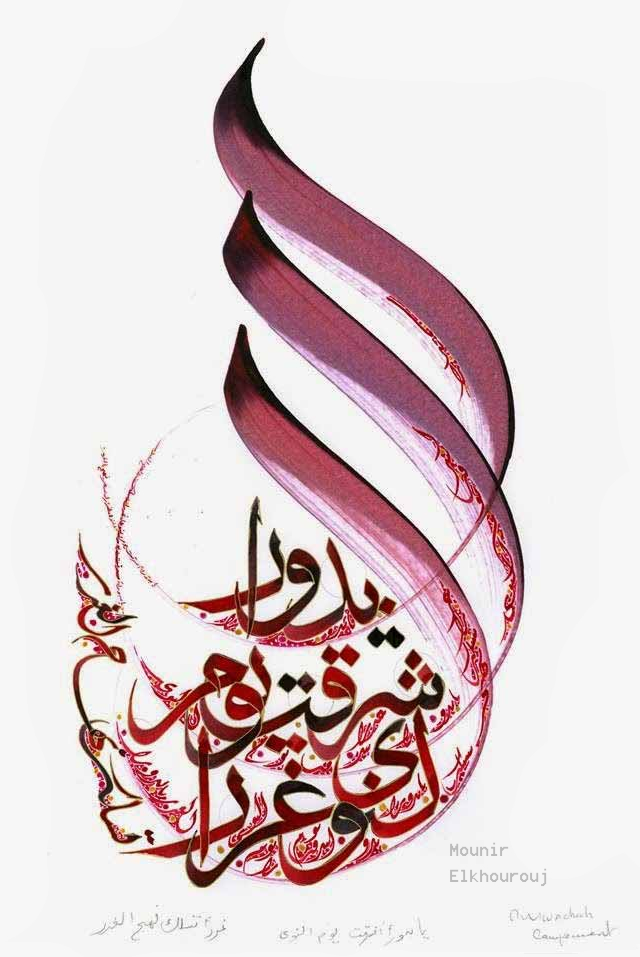
A BRIEF HISTORY OF ARABIC CALLIGRAPHY
Arabic script is most likely of Nabataean origin, a variant of Aramaic, itself descended from Phoenician — from which all the alphabets of the Mediterranean basin derive, such as Hebrew, Greek, Syriac, Latin, etc.
Arabic writing emerged with the advent of Islam, for the nomadic culture of the Arabian Peninsula favoured an essentially oral culture. The Qur’an played a central role in this genesis. As it happens, the very first Qur’anic revelation evokes the writing that God taught to Man: “He taught by the Pen, and taught Man what he did not know.” Qur’an XCVI, 4-5.
Since the Sacred Book gives such prominence to writing, Muslims could not neglect its typography. The need to magnify the word of God thus arose naturally, and calligraphy very quickly became an essential component of Arab-Muslim art.
Moreover, Islam’s prohibition on depicting human figures made this art form an indispensable resource for the ornamentation of monuments.
One of the founding masters of the art of the pen (qalam) is known as Ibn Muqla Shîrâzî (died 940).
He is at the origin of a fundamental principle: that of proportion. He also established a code and defined six classical styles, making calligraphy a rigorous discipline that his students then developed further.
Made compulsory by the Umayyad administration from the end of the 7th century, Arabic script underwent an extraordinary spread across the Near East and the Maghreb thanks to the expansion of the Muslim empire. The first copies of the Qur’an were written in the Hijazi style.
Other styles soon appeared, such as Naskh and Kufic.
Each region of the Muslim world gradually forged a typography reflecting its cultural traditions, making script a marker of identity. We find, for example, the Andalusian, Persian, Ottoman, and Maghrebi styles. Kufic: Kufic script was born in Kufa (Iraq), in the second decade of the Islamic era; it is the first style used for writing the Qur’an after the Hijazi. Then came styles influenced by each culture, such as Naskhî, Thuluth, Riqâʿ, Dîwânî, Jalî Dîwânî, Maghribî, Fârsî (or Taʿlîq), and Shikasta.
Today, contemporary calligraphers continue to develop this art.
Arabic courses at Institut Imtiyaz
The pursuit of excellence in teaching. Our online courses in Qur’anic Arabic and tafsîr (Qur’anic exegesis) are taught in French. Institut Imtiyaz

Go further
These topics come to life once you can read the language of the Qur’an. Our method Qur’anic Arabic guides you step by step, from the alphabet to reading the verses — on your own or with our courses.
Behind this art lies an ordinary gesture, one that can be learned in its plainest form. Readers who would like to trace the letters themselves — everyday handwriting rather than calligraphy — may begin with the Arabic Writing Workbook: Learn to Write the Arabic Alphabet.