
THE HISTORY OF THE QUR’AN
Timeline: the life of the Prophet and the revelation of the Qur’an.
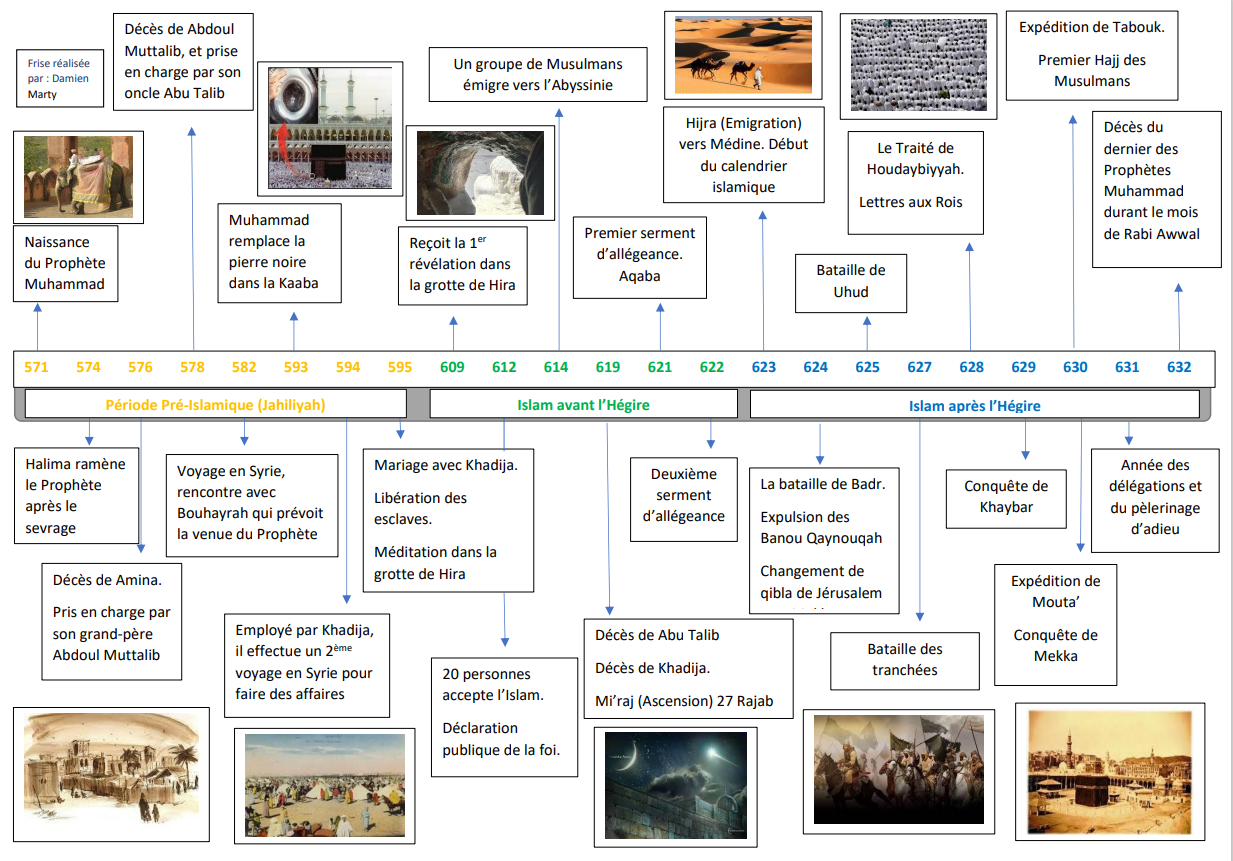

HISTORY OF THE COMPILATION AND TRANSMISSION OF THE QUR’AN
According to Muslim tradition, the Qur’an is the Word of God revealed to the Prophet Muhammad, a messenger whose duty was to transmit this Word to humanity.
According to the Qur’an itself, this Book is a physical representation of another Qur’an, uncreated and preserved in “the Preserved Tablet”. It was revealed gradually through the archangel Gabriel over 23 years.
STAGE 1
FIRST STAGE OF THE TRANSCRIPTION OF THE QUR’AN
The first took place during the Prophet’s lifetime. He ensured that all the revealed word was put into writing on various materials: leather, shoulder blades, palm leaves, gazelle hides, wooden tablets. Since Mecca lay on a trade route and Meccan merchants had to keep accounts, paper and ink were also available.
This was accompanied by a very broad movement of memorization of the text. A tradition recounts that in the Mecca of the Prophet’s time a kind of humming could be heard in the morning: it was the great number of Muslims chanting the Qur’an. Arab-Bedouin culture was essentially oral, and people were used to memorizing texts, poetry in particular.
Tradition relates that at the beginning of the Revelation, among the members of the Quraysh tribe, only seventeen people could read. As for Medina, a more rural region, they were even fewer.
But with the advent of Islam, literacy began, encouraged by the Prophet. By the end of his life, some forty scribes were working to transcribe the Qur’an — though this figure is much debated. Some of these literate men, such as Zayd and Ubayy, who knew Syriac and Hebrew, worked solely on this transcription.
Others were also tasked with writing the official correspondence of the new community. Among them were ‘Uthmān and ‘Alī. According to the tradition established from the hadiths, the Prophet himself is said to have indicated the order of the verses within the sūras and the order of the sūras within the Qur’an.
STAGE 2
SECOND STAGE: THE COMPILATIONS IN THE TIME OF ABŪ BAKR
The Battle of Yamāma. One year after the Prophet’s death, the Battle of Yamāma led to the death of hundreds of reciters of the Qur’an, according to estimates ranging from 70 to 450. This tragic event prompted the caliph Abū Bakr to gather the Holy Book into a single corpus. This was the second phase of compilation. ‘Umar asked that anyone possessing written verses bring them to him in order to establish a reliable compilation. No verse, tradition says, was accepted unless several people at minimum attested to its authenticity — that is, to the fact that the verse had been transcribed in the Prophet’s time.
It was Zayd, assisted by ‘Umar, who was chosen by the caliph Abū Bakr for this work in the year 13 of the Hijra (633 CE). It lasted fourteen months. The resulting compilation corresponds to the Qur’anic corpus as we know it today. A single version had thus been established and kept by Abū Bakr until his death. It then fell to the caliph ‘Umar, then to Ḥafṣa, his daughter and a wife of the Prophet. When the caliphate passed to ‘Uthmān, he made two copies of this initial Qur’an.
THE PARTIAL QUR’ANS
Before the Qur’anic corpus was gathered, the first Muslims and Companions of the Prophet possessed partial qur’ans — a few verses or sūras, in variable orders. Such possession was highly honorific. The names of twenty-three people who held these fragments of the Qur’an have come down to us. None of these fragments has been found to date, and the oldest known Qur’anic texts date from after the compilation.
STAGE 3
THIRD STAGE: THE UNIFICATION UNDER THE CALIPH ‘UTHMĀN
Islam spread rapidly into non-Arabic-speaking countries, and difficulties of pronunciation arose. The various Arabic accents of the peninsula added to the difficulty of agreeing on one or several canonical readings, as did pressure to accept all existing pronunciations.
Once again a group was assembled, still under the direction of Zayd, to unify all the existing compilations. The Arabic alphabet was still taking shape. The famous diacritical dots distinguishing certain letters were not yet fixed, which could give rise to several readings. The scribes therefore took care to use exactly the same spelling.
All the compilations, including that of Abū Bakr, were compared. Comparing the different compilations ensured the success of the unification that followed, for each compilation had its defenders. Thus a new Qur’anic corpus was transcribed, verifying authenticity, ensuring the correct order, and paying attention to the choice of spelling.
THE 7 READINGS
The differences in recitation gave rise to what are called the seven “readings”, qirā’āt or aḥruf in Arabic. Tradition recognizes the validity of these variants, which correspond to dialectal differences but generally have very minimal effects on the meaning of the text.
‘Umar recounts that one day he heard Hishām ibn Ḥakīm chanting the sūra “Al-Furqān” differently from what he had learned from the mouth of the Prophet.
He wanted to fall upon him but finally restrained himself and let him finish.
He recounts: “I took him to the Messenger of God — peace and blessings be upon him — and said: ‘I heard him recite in a manner different from the one you taught me!’ ‘Let him recite,’ he said. Hishām repeated his reading.
When he had finished, the Prophet declared: “That is indeed how it was revealed.
Indeed, the Qur’an was revealed according to seven readings (aḥruf). So recite it in whichever way is easy for you.” Take advantage of the Arabic courses in Geneva offered through the care of our school.
Care was therefore taken to transcribe the seven readings uniformly, so as not to mix them with one another. This is how the final compilation work of the Caliph ‘Uthmān was carried out without major dissension.
Following this, he asked that all personal compilations be gathered and destroyed. Some refused, so that manuscripts reappeared at various times. Two particular compilations were not destroyed: that of ‘Alī, which remained in his family, and that of ‘Abd Allah.
Once the compilation of the Qur’an was established, the scholars made many copies which were sent to all the Muslim lands, notably to the governors of the provinces of Kufa, Basra, and Shām (the Syrian region).
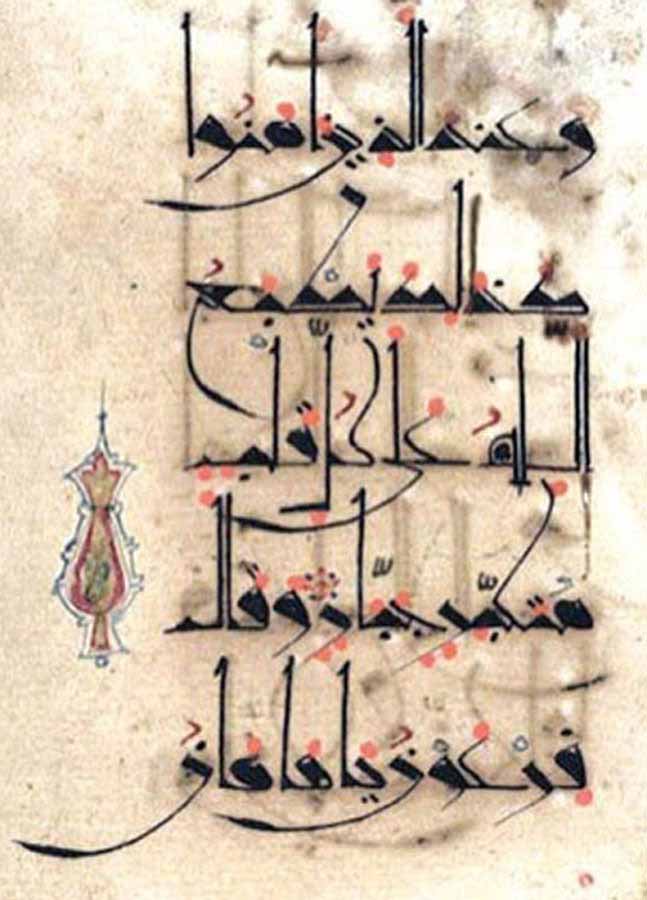
Arabic courses at Institut Imtiyaz
The pursuit of excellence in teaching. Our online courses in Qur’anic Arabic and tafsîr (Qur’anic exegesis) are taught in French. Institut Imtiyaz

Go further
These topics come to life once you can read the language of the Qur’an. Our method Qur’anic Arabic guides you step by step, from the alphabet to reading the verses — on your own or with our courses.
Much of what is discussed above rests on the Arabic of the Qur’an itself. Qur’anic Arabic 1: Understanding the Qur’anic language was written for readers who would rather meet that text in its own language than through translation; the method is outlined here.