
The first transmitters of hadîth
1 – The Companions of the Prophet
The people who transmitted the words, actions and deeds relating to the life of the Prophet Muhammad were none other than his Companions, then the generations that followed them, up to the 4th century of the Hijra. These are the people called the “Narrators of hadîth”. The science of hadîth set out to record the biography of these rigorously chosen individuals, out of concern for reliability in transmission. This whole biographical compilation is known as Asmâ’ al-rijâl, or the Names of the [Notable] Men. This colossal body of texts catalogues nearly one hundred thousand biographies.
Dr A. Springer, the great German scholar, hailed this unprecedented feat that Muslim historiography represents: “No people, as they did over twelve centuries, has written the biography of its men of letters. Were we to compile a collection of Islamic biographical accounts, we would enumerate nearly half a million men.”
The Farewell Pilgrimage, tradition says, gathered more than 100,000 Companions. History has recorded the biographies of about 11,000 of these men who took part in the transmission of the hadîths. The Prophet died in the year 11 of the Hijra, that is, 632 CE. The veteran Companions, for their part, lived until the year 40 of the Hijra, that is, 660 CE. Anas ibn Mâlik, the last of the Companions to die, was the servant of the Prophet for ten years.
The Successors and the earliest transmission of hadîth
2 – The Successors, or the tâbi‘ûn
The period of the Successors — called in Arabic the Tâbi‘ûn — in fact began from the Hijra. For some of them saw the Prophet but did not converse with him directly. They did, however, all keep company with his Companions. During the Prophet’s lifetime, a great number of these Successors had therefore already been born.
This is the case of ‘Abd al-Raḥmân ibn al-Ḥârith, born in the year 3 of the Hijra; of Qays ibn Abî Ḥâzim, born in the year 4 of the Hijra; or of Sa‘îd ibn al-Musayyab, born in the year 5 of the Hijra. According to an account by Ibn Sa‘d, in the city of Medina alone 335 Successors were counted. The others were scattered across Mecca, Damascus, Basra, Taif, Kufa, Yemen and Egypt. The following table gives the number of traditions transmitted by certain notable Companions:
| Companion’s name | Number of hadîths |
| Abû Hurayra (died 59/678) | 5374 |
| ‘Abd Allah ibn ‘Abbâs (d. 68/687) | 1660 |
| ‘Â’isha (d. 58/677) | 2220 |
| ‘Abd Allah ibn ‘Umar (d. 73/692) | 1630 |
| Jâbir ibn ‘Abd Allah (d. 78/697) | 1560 |
| Anas ibn Mâlik (d. 93/711) | 1266 |
| Abû Sa‘îd al-Khudrî (d. 74/693) | 1170 |
ORAL OR WRITTEN TRANSMISSION?
In the oral culture of nascent Islam, texts were above all memorized. The Companions were reluctant to commit the hadîths to writing, for several reasons. Firstly, because the Prophet himself, at the beginning of the revelation, had forbidden transcribing any word other than the Qur’an, so as to avoid any confusion. He later gave his permission, but the Companions remained cautious. Some, moreover, considered that writing had the drawback of leading to laziness and to neglecting memorization.
Hadîths written down in the Prophet’s lifetime
Several hadîths were nonetheless transcribed during the Prophet’s lifetime. This is notably the case of the sermon he gave on the day of the conquest of Mecca. Bukhârî and other hadîth compilers relate that, at the request of a Companion from Yemen named Abû Shâh, it was put into writing. Abû Hurayra once stated that, apart from ‘Abd Allah ibn al-‘Âṣ, no one held a larger collection than his own — for the latter, unlike Abû Hurayra, wrote down everything he heard from the Messenger of God.
The collection Al-Sunan by Abû Dâwûd, as well as the Musnad of Ibn Ḥanbal, relate that ‘Abd Allah ibn ‘Amr had resigned himself to no longer recording the words of the Prophet. For he saw that the Messenger of God’s recommendations or remarks did not apply in every circumstance, and that this could therefore lead to errors of judgement. He mentioned this one day in the presence of the Prophet, who pointed to his lips and declared: “You may write. Everything that comes out of these lips is valid and true.” He thus left it to each person to determine the right context in which a given saying applies.
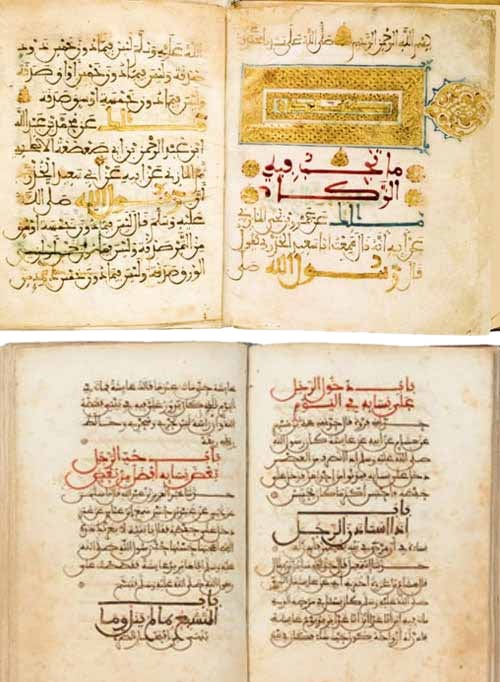
The first official compilation and the rules of authenticity
It was during the caliphate of ‘Umar ibn ‘Abd al-‘Azîz, who died in 101 of the Hijra (719), that as many hadîths as possible were gathered. Copies of the resulting collection were sent to all the capitals of the empire. This was the first official attempt to compile the hadîths. ‘Umar ibn al-Khaṭṭâb had considered it long before, but fearing that it might be regarded as a bid‘a (a blameworthy innovation), he had gone back on his decision.
To ensure the authenticity of the hadîths, Muslim scholars established very strict rules. The initial narrator had to be a direct witness of the event, and the integrity of each transmitter had to be above all suspicion.
OVERVIEW OF THE MAIN HADÎTH COLLECTIONS
From the Muwaṭṭa’ to the six canonical collections
1 – FROM THE 2ND TO THE 5TH CENTURY OF THE HIJRA
After the collection commissioned by ‘Umar ibn ‘Abd al-‘Azîz mentioned above, others appeared. A Medinan scholar named al-Zuhrî (died 124 AH/741) compiled a collection of which the only traces are the testimonies of historians and scholars. Collections then followed one another. About fifteen of them date from the second century of the Hijra. The best known is none other than the Muwaṭṭa’ of Imâm Mâlik (died 179 of the Hijra/795). About thirty date from the third century of the Hijra. The most famous are six reference works of Sunnism: the two collections bearing the title “ṣaḥîḥ” (that is, authentic) — namely Ṣaḥîḥ Bukhârî and Ṣaḥîḥ Muslim — and the four collections called Sunan, namely the Sunan of Abû Dâwûd, of Tirmidhî, of al-Nasâ’î and of Ibn Mâjah. Another fifteen or so date from the fourth century of the Hijra. A few collections, finally, date from the fifth century of the Hijra.
The great later compilations and Kanz al-‘Ummâl
2 – FROM THE 6TH TO THE 12TH CENTURY OF THE HIJRA
From the 6th century onwards, the work of hadîth scholars consisted in compiling, and reorganizing by theme or alphabetical order, the thousands of hadîths already present in earlier collections, avoiding repetition as far as possible. An important title of the period is that of ‘Alâ’ al-Dîn al-Hindî (died 975 AH/1567), entitled Kanz al-‘Ummâl.
It mentions no fewer than 46,624 hadîths. He drew on 92 collections, a large number of which are still in manuscript form or simply lost
. It is thanks to such works that the content of older collections has been preserved. The characteristic of these great compilations is that they do not cite the chains of transmitters, these being available in the source works. The authors nonetheless made a critique of the contents and of the chains of guarantors, in order to classify the hadîths according to their degree of reliability.
Arabic courses at Institut Imtiyaz
The pursuit of excellence in teaching. Our online courses in Qur’anic Arabic and tafsîr (Qur’anic exegesis) are taught in French. Institut Imtiyaz

Go further
These topics come to life once you can read the language of the Qur’an. Our method Qur’anic Arabic guides you step by step, from the alphabet to reading the verses — on your own or with our courses.
Learn Qur’anic Arabic
Understanding the Qur’an begins with its language. At Institut Imtiyaz, Qur’anic Arabic is taught from the Qur’anic text itself — from the alphabet to the reading of full passages, in groups of no more than nine students.
Institut Imtiyaz teaches its classes in French. The textbook sets out the same method in English, for readers working on their own: Qur’anic Arabic Textbook: Understanding the Qur’anic language, on Amazon.