
The 12 units of Volume 1 — audio files, PowerPoint slides and materials for every lesson
Our new method for Qur’anic Arabic is a complete reworking of Volume 1, drawing on twenty years of teaching experience and pedagogical observation. Designed to bring beginners progressively into a working understanding of the Qur’anic text, it articulates grammar, vocabulary and oral expression across two years of study. Its structure — ten progressive units punctuated by review units and tests — suits both the independent learner and the teacher seeking a ready-to-use framework for class. Classes at Institut Imtiyaz are taught in French and are open to students of any mother tongue who can follow a lesson in French; this English edition of the textbook is designed for independent study.
Read the author’s introduction ↓
What is this new method?
The term “new method” refers to the complete reworking of Volume 1 of our Qur’anic Arabic method, fully redesigned for this 2026 edition. The overall three-volume structure — covering a full pathway from the alphabet to the independent reading of sûras — remains unchanged. Only Volume 1 has been reworked.
This new edition focuses on two main aspects. First, a deepening of substance: the dialogues closing each unit now address the maqâṣid — the essential Qur’anic purposes — so that linguistic learning leads to a genuine encounter with meaning. Second, a substantial enrichment of activities and exercises, supported by new audio materials designed to durably anchor vocabulary and listening.
A progressive structure over two years of study
Volume 1 comprises ten teaching units and two review units, each divided into five lessons — sixty lessons in total, spread across two years of study. The review units allow learners to consolidate their progress before moving on to the next stage of the pathway.
The recommended pace is at least one and a half hours of formal teaching per week, complemented by a reasonable amount of personal review — re-reading lessons, memorizing vocabulary, redoing exercises. At this pace, completing Volume 1 takes two years, matching the two annual cycles held at Institut Imtiyaz.
The only prerequisite is mastery of the Arabic alphabet. The textbook itself is designed for learners already familiar with Arabic script. For absolute beginners, three introductory videos on the Arabic alphabet are available free of charge (English voice-over; the text on the slides is in French). A Unit 1 specially designed for non-literate students is also available free of charge on the Unit 1 page.
A pedagogy rooted in the Qur’an
The whole method rests on a clear pedagogical principle: treating the Qur’anic text not as the endpoint but as the “starting point” of learning. From the very first lessons of Unit 1, learners use their first Qur’anic words and read their first verses.
Lessons use only words from Qur’anic roots — exceptions are flagged where they occur. This lexical discipline, combined with a coherent grammatical progression, enables learners to gradually engage with longer and longer Qur’anic passages. In addition, each unit opens with a “proverbial” Qur’anic passage to be memorized, chosen as much for its linguistic reach as for its illumination of meaning.
Learning covers the four skills: listening, reading, speaking and writing. For pedagogical reasons, the translations provided are deliberately quite literal.
Who is this method for?
This method is intended for anyone wishing to access the language of the Qur’an, with no prerequisite other than mastery of the Arabic alphabet. It is particularly suited to beginners eager to enter progressively into the Qur’anic text, as well as to learners who already have some grounding but seek a structured framework to deepen it.
The pedagogical format has been designed to work equally well in independent study and in class. Independent learners will find a clear progression, audio materials, and self-correcting exercises. Teachers, for their part, have access to pedagogical notes and summary memos, allowing them to build their lessons without starting from scratch.
The method is primarily addressed to adults and adolescents, but its contents remain adaptable for school use from middle-school level upward.
Author’s Introduction
This textbook — Volume 1 of the three-volume Qur’anic Arabic method, fully redesigned — was designed to enable a genuine understanding of the Qur’anic text, not only linguistically but also in its deeper meaning (the maqâṣid of the Qur’an), addressed in the dialogues that close each unit.
Foreword
Five years have passed since the publication of Qur’anic Arabic, an Arabic learning method based on the Qur’an. In the meantime, volumes 2 and 3 were published (in French). Experience and high standards led me to completely redesign volume 1, which can be considered a new work in its own right.
I greatly expanded the content, particularly in the final dialogues, which address the central themes of the Qur’an — what are known as the ghâyât or maqâṣid, the fundamental objectives of the Qur’anic message. This textbook should not be limited to the linguistic dimension alone; it should also give learners keys to reading and understanding the sacred Text.
The Method’s Purpose
Designed for teachers and independent learners alike, this book guides students step by step through Arabic learning, with the primary objective of understanding the Qur’anic text. It combines detailed study of Qur’anic grammar with oral and written practice based on words and roots drawn exclusively from the Qur’an.
From the very first pages, learning is illustrated with verses or excerpts from verses. The method never asks students to memorise texts without understanding them.
Although initially designed for adults and teenagers, much of the pedagogical material can also be used for teaching children.
Structure
The book comprises 10 + 2 units (revision units) and three exams. Each unit contains 5 lessons — 60 lessons in total, covering the equivalent of two years of study at 1.5–2 hours per week.
Unit 1 is designed for students who already know the alphabet. A version for complete beginners (learning the alphabet) is available free of charge on the website.
Pedagogy
Each unit develops the four skills: listening comprehension, reading comprehension, speaking, and writing. “Pedagogical thread” notes guide teachers through the activities.
Resources
Audio recordings, interactive PowerPoint files (“Safar”) and downloadable memo sheets summarising grammar and key phrases are available on the website. Resources accompany each unit: see the unit pages above, starting with Unit 1.
Qur’anic Grounding
Learners will read their first Qur’anic words from the earliest lessons. Each unit opens with a proverbial Qur’anic passage and closes with a deeper reflection. The final dialogues address the maqâṣid — the fundamental objectives of the Qur’anic message — so that this manual opens not only onto the language but also onto the meaning of the sacred Text.
Study with Institut Imtiyaz — These materials accompany the method taught at Institut Imtiyaz. Discover our courses · Qur’anic Arabic courses
See also: Qur’anic Arabic — overview of the method · A Quest for Arabic Language — Modern Arabic A1 · All the author’s books in the shop
How to obtain the method
The textbook is available in English under the title Qur’anic Arabic Textbook: Understanding the Qur’anic language, for sale on Amazon – in a color edition or a more affordable black-and-white edition. All supporting materials — audio recordings, PowerPoint slides, additional teaching documents — are accessible directly from each unit’s page on this site.
To join a class at Institut Imtiyaz (classes are taught in French), see our Courses page.
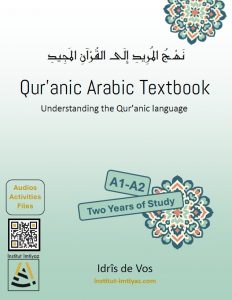
New method · Volume 1
Qur’anic Arabic Textbook
Available in paperback on Amazon, in a colour edition and a more affordable black-and-white edition. All supporting materials are free on this site.
Buy the textbook on AmazonBlack-and-white edition on Amazon →Courses at Institut Imtiyaz (taught in French) →