
A Quest for Arabic Language — Modern Arabic Method
A progressive method across the four levels of the Common European Framework of Reference for Languages (CEFR), designed to take learners from discovery to autonomy in Modern Arabic.
Level A1 — Discovery
Textbook published. First level of the method: language basics, first exchanges, first texts.
Discover → A2Level A2 — Survival
Coming soon — second level to communicate in everyday situations.
Coming soon B1Level B1 — Threshold
Coming soon — intermediate level to discuss familiar topics.
Coming soon B2Level B2 — Advanced
Coming soon — advanced level to grasp the essentials of complex texts.
Coming soonOther resources
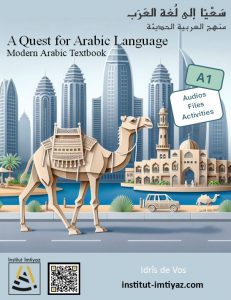
Modern Arabic textbook · Volume 1 (level A1)
A Quest for Arabic Language
The textbook is available in paperback on Amazon. The accompanying audio files and documents are freely available on this page.
Buy the textbook on AmazonRead the author’s introduction ↓In-person course with the author in Geneva (ifage):

A Quest for Arabic Language, Modern Arabic Method A1
Here you will find the audio files for the method, as well as other course materials.
The first 5 lessons for free
Additional videos for learning the Arabic alphabet and handwriting
Note: these videos were originally recorded for the ‘Qur’anic Arabic’ method, but this makes no difference here.
Audio files and documents
Lesson 1
Writing practice sheets
Snakes and Ladders
Audio “Greetings”
Audio “First Words”
Lesson 2
First Words, Sukun
First Sentences
Grammar Sentences
What is This
Lesson 3
Shadda and Tanwîn
Dialogue 1, Vocabulary
Dialogue 1, Text, (Slow
Dialogue 1, Text, (Quick
Dialogue 1, Questions and Exercise
Lesson 4
Read and Write the Sentences in Arabic
Grammar Phrases
Images Descriptions, Vocabulary
Lesson 5
Long Vowels
Phonetics 1
Conjugation
Majid and Malika 1
Lesson 6
Laysa Complete
Exercise, Deduct
Dialogue 2, Text (Slow
Dialogue 2, Text (Quick
Dialogue 2, True or False, and Questions
Lesson 7
Safar 1, Part Two
In Every Way
Lesson 8
Phonetics 2
Where are You Going?
Verbs in Context
Reading and Deduction
Lesson 9
Expression of Possession
Dialogue 3, Text (Slow
Dialogue 3, Text (Quick
Lesson 10
The Three Middle Vowels
Job Names
Yassin the Omani 1
Example of Dialogue
Lesson 11
Majid and Malika Continued
Presentation 2, Vocabulary
Presentation 2, Text
Lesson 12
The Future
Dialogue 4, Text (slow
Dialogue 4, Text (quick
Dialogue 4, Questions
Lesson 13
Listening
The future , Vocabulary,
Yassin the Omani 2
Yassin the Omani 2, Questions
The Numbers
Lesson 14, Review
Simsim, vocabulary
Simsim, questions
Active Listening
Life Here, Text
Life here, Questions
Habib’s Day
Reading Without Vowels
Images and Texts
Losson 15, Test1
In Qatar, Text
In Qatar, True or False
In Qatar, Questions
Lesson 16
Affix Pronouns, Part One
Lesson 17
Complete the Translations
Listen and Translate from Memory
Translation Errors
Lesson 18
Dialogue 5, Text
Dialogue 5, Questions
Lesson 19
Proverb and Poem
Complete Imperfective Form
Find the Intruder
Dual and Plural of the Imperfective Form in Context
Oral Conjugation, Example
Complete the Translations
Choose the Right Translations
Say Who Does What
Lesson 20
Give Direction 1
Give Direction 2
PowerPoint: Giving directions
Lesson 21
Dialogue 6, Text
Dialogue 6, Questions
Colors
Three Summaries of the Dialogue
Lesson 22
Nouns of Instruments, Objects, Places, and Times
Place and Time Nouns in Context
Place and Time Nouns in Context (revised version)
Yassin the Omani 3
Lesson 23
Duels and Plurals
The Numbers
Read the Sentences
“How Much” Activity
Lesson 24
Dialogue 7, Text
Dialogue 7, Summary
Lesson 25
The Pperfective Form
Who Ate Tagine?
Younes’ Day
Younes’ day, Questions
Lesson 26
Useful Expressions to Know
Bashir and Bouchra
Lesson 27
Dialogue 8, Text
Dialogue 8, Questions
Dialogue 8, Summary
Lesson 28
The History of Elephants in Mecca
The History of Elephants in Mecca, questions
Lesson 29
Qur’anic Proverbs
Correspondences, Qur’an
Deductions From Translations, Qur’an
Descriptions of Mecca
Descriptions of Mecca, True or False
Descriptions of Mecca, Questions
Translations of Qur’anic Passages
Lesson 30
The Nil, Text
The Nile, True or False
The Nile, Multiple Choice Questions
The Nile, Open Questions
Adnan, Text
Adnan, True or False
Test 2
Seaside, Text
Seaside, True or False
Author’s Introduction
A Quest for Arabic Language is a modern Arabic method in four volumes (Volume 1, level A1, available) that fills a gap: combining concrete, spoken Arabic practice with an immersion in Arab civilisation and literature.
Foreword
Welcome to those of you who are in quest of the Arabic language. This modern Arabic textbook, Volume 1 (A1 level), is aimed at all those who wish to discover the Arabic language and culture from the very first letters and without any prior knowledge. Designed for concrete language practice combined with a journey of the mind, this first volume builds solid linguistic foundations while immersing you in the cultural and literary world that gave birth to this language.
Having completed Qur’anic Arabic in three volumes, and building on its success, I wished to create a new textbook for an audience more oriented towards Arabic literature, arts and culture in general. These two methods are highly complementary, as the Arabic language is deeply marked by Islamic religion and spirituality.
As a graduate of the Sorbonne in Arabic language and civilisation, this linguistic journey came to me naturally. I know from experience that minds in quest of Arabic appreciate receiving this knowledge in its cultural and literary setting, rather than studying a sanitised language devoid of personality. And yet no Arabic method currently meets this dual objective: practising Arabic concretely with a focus on oral skills, while discovering the civilisation that gave birth to and shaped this language.
Who is this method for?
Anyone drawn to Arab culture, literature and civilisation — not only for religious reasons. It is suitable for both teachers and self-learners.
Objectives of Volume 1
- Master the fundamentals: alphabet, pronunciation, basic vocabulary, and simple grammatical structures.
- Communicate in everyday situations: introduce yourself, ask for information, describe your environment, talk about yourself and your family.
- Explore culture: each dialogue and text opens a window onto cultural, civilisational or literary realities.
Method and Structure
After 20 years of teaching and in-depth study of language didactics, I have adopted a pragmatic approach: at each stage, what activities can be carried out with what has been learned? The emphasis is on oral expression — the most difficult skill at beginner level. Interactive PowerPoint files on the website allow oral practice from concrete objects and characters.
The method develops all four skills: listening, speaking, reading, and writing. It is designed primarily for teacher-led courses, but much of the content can be used by self-learners. It draws on online resources — audio files, grammar summaries and interactive PowerPoint files — gathered in the Audio files and documents section of this page.
Cultural Content — A Chronological Journey
Volume 1: The cradle of the language — the Arabian desert, pre-Islamic poetry, the great cities of Arabia, cuisine, the language of the Qur’an.
Volume 2: Medina and Damascus — hadiths, biographies, the Umayyad period, calligraphy and sciences.
Volume 3: Baghdad — the Abbasid era, One Thousand and One Nights, Andalusia and its literary treasures.
Volume 4: The Ottoman and modern era — cultural and literary transformations.
Modern Arabic textbook · Volume 1 (level A1)
Ready to begin the journey?
Volume 1 of A Quest for Arabic Language is available in paperback on Amazon.
Buy the textbook on AmazonAll the author’s books in the shop →